
Investigating the crisis in federal custody and the reporters being jailed for exposing it.
They want you to look away. We are looking closer.
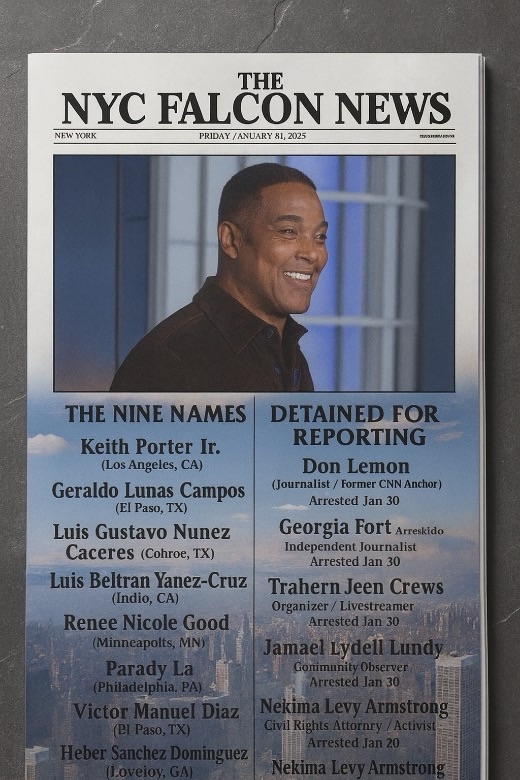
In a coordinated suppression of the press, five independent journalists—including former anchor Don Lemon—have been arrested. Their crime? Attempting to report on the inexplicable deaths of nine individuals in federal custody.
This is not just a story about prison statistics; it is a story about the systematic dismantling of your right to know. Below is the full audio breakdown of the facts they tried to hide.

INVESTIGATIVE DOSSIER: OPERATIONAL LETHALITY IN FEDERAL IMMIGRATION ENFORCEMENT (2025–2026)
A Forensic Verification of the “Nine Names” and Systemic Analysis of Use-of-Force Anomalies
1. Executive Summary and Investigative Mandate
In the final week of January 2026, a graphic and politically charged image began circulating across decentralized social media networks and independent news platforms. The image, depicting a civilian in acute distress while being restrained by federal agents, was overlaid with white text listing nine names. This list—Alex Pretti, Renee Nicole Good, Keith Porter Jr., Heber Sanchez Dominguez, Victor Manuel Diaz, Parady La, Luis Beltran Yanez-Cruz, Luis Gustavo Nunez Caceres, and Geraldo Lunas Campos—became a rallying cry for protests in Minneapolis and beyond, coalescing under the banner of “Say Their Names.”
The emergence of this list coincided with a marked escalation in federal interior enforcement operations, specifically “Operation Metro Surge,” initiated by the second Trump administration. The period in question, stretching from late 2025 through January 2026, represents a statistical anomaly in the history of Immigration and Customs Enforcement (ICE) and Customs and Border Protection (CBP) interactions, characterized by a sharp spike in fatal encounters involving both foreign nationals and U.S. citizens.
This report, commissioned to verify the identities of these nine individuals and the circumstances of their deaths, functions as a comprehensive forensic audit. Leveraging data from international wire services (Reuters, AP), domestic political reporting (Politico, NY Post), and independent progressive journalism (Democracy Now, Thom Hartmann, Democracy Docket), this document confirms that all nine individuals died between December 31, 2025, and January 24, 2026, while in federal custody or during confrontations with federal agents.
The analysis reveals that these deaths were not isolated administrative failures but the direct downstream consequences of specific policy shifts: the implementation of the “Turn and Burn” enforcement doctrine, the deployment of tactical border units (BORTAC) to urban centers, the relaxation of engagement rules regarding “agitators,” and the systemic collapse of medical standards in rapidly expanded “soft-sided” detention facilities.
2. The Geopolitical and Operational Landscape (2025–2026)
To fully comprehend the mechanisms that led to the deaths of the nine verified individuals, it is necessary to reconstruct the operational environment of the Department of Homeland Security (DHS) during the transition into 2026. The second Trump administration, having taken office in January 2025, spent its first year laying the logistical groundwork for a mass deportation agenda. By early 2026, this agenda had transitioned from planning to kinetic execution.
2.1 The “Turn and Burn” Doctrine
The defining operational philosophy of this period was articulated by Border Patrol Commander Gregory Bovino, who was redeployed to Minneapolis to oversee “Operation Metro Surge.” Bovino explicitly described the strategy as a “turn and burn” approach. In military aviation, this term refers to rapid refueling and rearming to return to combat immediately. In the context of interior immigration enforcement, it mandated high-velocity target processing:
- Objective: Maximize arrest volume to meet deportation quotas.
- Tactic: Agents were instructed to move from “target to target” without the traditional “surveillance-heavy” preparation that characterized ICE operations in previous administrations.
- Mechanism: The use of “administrative warrants”—documents signed by immigration officials rather than judges—to force entry into homes and businesses, bypassing judicial oversight.
This prioritization of speed over procedural caution created a high-friction environment where agents, pressured to maintain tempo, were more likely to escalate encounters with non-compliant subjects.
2.2 The Militarization of Minneapolis: “Operation Metro Surge”
Minneapolis was selected as a primary theater for this new enforcement model, likely due to its status as a sanctuary jurisdiction and a hub of organized civil resistance. The administration deployed not just ICE Enforcement and Removal Operations (ERO) officers, but also U.S. Border Patrol agents and BORTAC (Border Patrol Tactical Unit) teams. These units, trained for rural interdiction and cartel engagement, possess a significantly more aggressive engagement profile than standard interior investigators.
The friction was immediate. The presence of camouflage-clad federal agents in urban residential neighborhoods provoked large-scale protests. The administration framed these protesters not as citizens exercising First Amendment rights, but as “agitators” and “disruptors” impeding federal law enforcement. This rhetorical shift is critical; by classifying protesters as operational impediments, the rules of engagement were effectively loosened, allowing for the use of lethal force in scenarios—such as the Alex Pretti case—where de-escalation would historically be mandated.
2.3 The “Black Hole” of Detention
Simultaneously, the detention infrastructure was overwhelmed by the influx of detainees. To accommodate the surge, DHS expanded the use of “soft-sided” facilities—essentially militarized tent cities. The most notorious of these was Camp East Montana, located at Fort Bliss in El Paso, Texas.
Referenced by independent media as “Alligator Alcatraz” (a colloquialism carried over from Florida facilities) or a “legal black hole,” Camp East Montana became the site of a cluster of deaths in January 2026. The facility operated with limited transparency, utilizing private contractors for medical and security services. Reports from Democracy Now and The Guardian indicate that the facility suffered from a breakdown in the “duty of care,” with medical staff overwhelmed and security personnel resorting to excessive physical control measures to manage the population.
3. Forensic Case Studies: The “Nine Names”
The following sections provide a detailed forensic accounting of the nine individuals listed in the viral image. The deaths are categorized by the nature of the incident: Street-Level Enforcement Killings (Minneapolis/Los Angeles) and Custodial Deaths (Detention Centers).
3.1 The Minneapolis Flashpoint: Escalation to Lethality
Two of the most prominent names on the list, Renee Nicole Good and Alex Pretti, were U.S. citizens killed in Minneapolis. Their deaths serve as the primary indicators of the breakdown in engagement protocols during Operation Metro Surge.
Case 1: Renee Nicole Good
- Date of Incident: January 7, 2026
- Location: Minneapolis, Minnesota
- Demographics: 37-year-old Female, U.S. Citizen.
- Status: Deceased (Gunshot wounds).
- Involved Agent: ICE Officer Jonathan Ross.
The Official Narrative vs. Forensic Reality:
Initial reports from DHS and the White House characterized Renee Good as an aggressor who utilized her vehicle, a Honda Pilot, as a lethal weapon against federal agents. Administration officials claimed Officer Jonathan Ross fired in self-defense as Good attempted to run him down.
However, a forensic review of bystander video and traffic camera footage by the Associated Press and independent investigators contradicted this account. The footage demonstrated that:
- Good was “turning the wheels of her Honda Pilot away” from Officer Ross at the moment of the shooting.
- The vehicle was moving slowly and not directly toward the officer.
- Audio analysis captured Good’s final words to the officer: “I’m not mad at you.” This statement, uttered seconds before lethal force was applied, suggests a non-aggressive, perhaps confused, state of mind rather than lethal intent.
Systemic Implication:
The killing of Good illustrates the “pre-emptive threat” mindset ingrained in the Metro Surge units. Movements that would be interpreted by local police as flight or non-compliance were interpreted by federal agents as lethal threats. The Department of Justice, aligning with the executive branch’s enforcement priority, declared there was “no basis for a criminal civil rights investigation,” effectively immunizing Officer Ross from federal prosecution and blocking state-level inquiries by the Minnesota Bureau of Criminal Apprehension.
Case 2: Alex Pretti
- Date of Incident: January 24, 2026
- Location: Minneapolis, Minnesota
- Demographics: 37-year-old Male, U.S. Citizen, ICU Nurse (VA Medical Center).
- Status: Deceased (Multiple gunshot wounds).
- Involved Agents: U.S. Border Patrol Tactical Unit (BORTAC).
The “Agitator” Classification:
Alex Pretti’s death is the most politically contested of the nine. A nurse who treated veterans, Pretti was active in documenting the conduct of federal agents in his city.
- Prior Contact: Eleven days prior to his death (Jan 13), Pretti was filmed in a physical altercation with agents after kicking the tail light of a federal vehicle. He was tackled, beaten, and tear-gassed but released. This incident suggests he was a “marked” individual to the agents operating in that sector.
- The Killing: On Jan 24, amidst a protest, Pretti was engaged by a group of six agents.
- DHS Narrative: Homeland Security Secretary Kristi Noem and other officials immediately branded Pretti an “armed disruptor” and “would-be assassin” who approached agents with a gun intending to “massacre” them.
- Video Evidence: Multiple angles of bystander video tell a different story. Pretti is seen holding a cell phone, not a firearm, while recording agents. An officer pushes him; he is then tackled by a swarm of six agents. While Pretti was a licensed concealed carry permit holder, video shows an agent removing a gun from Pretti’s waistband during the struggle, stepping back, and then firing while Pretti was pinned to the ground.
- Date of Incident: December 31, 2025 (New Year’s Eve).
- Location: Northridge (Los Angeles), California.
- Demographics: 43-year-old Black Male, Father of two.
- Status: Deceased (Gunshot wounds).
- Involved Agent: Off-duty ICE Agent Brian Palacios.
- Date of Death: January 3, 2026.
- Location: Camp East Montana, El Paso, Texas.
- Demographics: 55-year-old Cuban National.
- Official Cause: Homicide (Asphyxia due to neck and torso compression).
- Date of Death: January 14, 2026.
- Location: Camp East Montana, El Paso, Texas.
- Demographics: 36-year-old Nicaraguan National.
- Context: Detained in Minneapolis during the Metro Surge.
- Date of Death: January 14, 2026.
- Location: Robert A. Deyton Detention Facility, Lovejoy, Georgia.
- Demographics: 34-year-old Mexican National.
- Cause: Hanging/Suicide (Disputed).
- Date of Death: January 9, 2026.
- Location: FDC Philadelphia.
- Demographics: 46-year-old Cambodian National/Refugee.
- Cause: Mismanaged drug withdrawal.
- Luis Gustavo Nunez Caceres: 42, Honduran. Died Jan 5 in Conroe, TX (Heart failure).
- Luis Beltran Yanez-Cruz: 68, Honduran. Died Jan 6 in Indio, CA (Heart failure).
Discover more from America The Beautiful
Subscribe to get the latest posts sent to your email.
