
A Peek Under the Hood: Revisionist History 101

From Whitewashed Museums to Weaponized Maps—How Our Reality is Edited.

• Author: Jairo Bonilla (NYC FALCON)

• Category: Independent Journalism / Historical Analysis / Activism

• Tags: #RevisionistHistory, #TheCartographicLie, #IndependentJournalism, #MercatorProjection, #CivilRights, #Truth

• Reading Time: 4 Minutes

The Narrative of Erasure

We are living in an era of active, real-time revisionism.

I recently witnessed footage that should disturb any student of history: men physically removing art pieces from a historical center. These were not just decorations; they were depictions of the brutal realities of the Civil Rights era, the atrocities committed against Native Americans, and the enslavement of Africans.

This was not a renovation. It was a sanitization.

By physically removing these reminders, institutions are attempting to “blank out” sections of history. It is a visual whitewashing designed to comfort the comfortable and silence the past. But this erasure of physical art is only the tip of the iceberg. The most dangerous form of revisionism isn’t what they take down from the walls—it’s what they have permanently hung in our classrooms.

The Muzzle of Academia

For decades, mainstream education has served not as a tool for enlightenment, but as a muzzle on our common sense. Those of us who study history independently—outside the constraints of approved curriculums—have always known that the “official” version of the world is often a fabrication.

Nowhere is this more evident than in the maps we are forced to memorize.

The world map is not a neutral objective image. It is a political weapon. For centuries, religious and colonial powers commissioned cartographers not just to navigate the world, but to dominate it psychologically. The goal was simple: to visually represent the “growth” and superiority of the Christian, Euro-centric world by artificially inflating the size of the Northern Hemisphere while shrinking the Global South.

The Cartographic Lie: Two Examples You Need to Know

To understand how deep this lie goes, we have to look at the specific tools used to distort our reality.

1. The Mercator Projection (The Lie We Were Taught)

This is the standard map hanging in almost every school in America. Created in 1569 by Gerardus Mercator, it was originally designed for European navigators. However, it came to serve a different purpose: imperial arrogance.

• The Distortion: On this map, North America and Europe appear massive, while Africa and South America look surprisingly small.

• The Reality: In reality, Africa is three times the size of North America and larger than all of Europe, China, and the United States combined. Greenland appears the same size as Africa on the Mercator map; in reality, Africa is 14 times larger than Greenland.

• The Agenda: By placing Europe at the center and inflating the size of predominantly white, Northern nations, this map subconsciously reinforces the idea that these cultures are more significant, powerful, and “grand” than those in the Southern Hemisphere.

2. The Gall-Peters Projection (The Corrective Lens)

In the 1970s, the Gall-Peters projection gained prominence as a counter-argument. This map prioritizes equal area.

• The Shift: It looks “stretched” to our eyes only because we have been conditioned to see the distortion as normal.

• The Truth: It shows the continents in their correct relative proportions. Suddenly, the Global South (Africa, South America) dominates the image, revealing the true scale of the non-European world. It is a humbling correction to centuries of visual propaganda.

Conclusion: Take Off the Muzzle

When you see art being removed from a museum, or when you look at a map that shrinks an entire continent of people, understand that these are not accidents. They are choices.

Revisionist history is the attempt to curate the past to protect the power structures of the present. As independent journalists and thinkers, our job is to reject the muzzle. We must question the map, document the erasure, and refuse to let the “official narrative” replace the truth.

The veil is lifting. It is time we help pull it down completely.
The Invisible Conductor: Finding Harmony in Chaos

The Fusion of Two Worlds

To the listener, what you are hearing might sound like a carefully rehearsed, pre-written concert piece. The melody weaves through the bassline as if they were born together. But the reality is much more visceral. This is a live experiment in musical intuition.

The Technical Feat

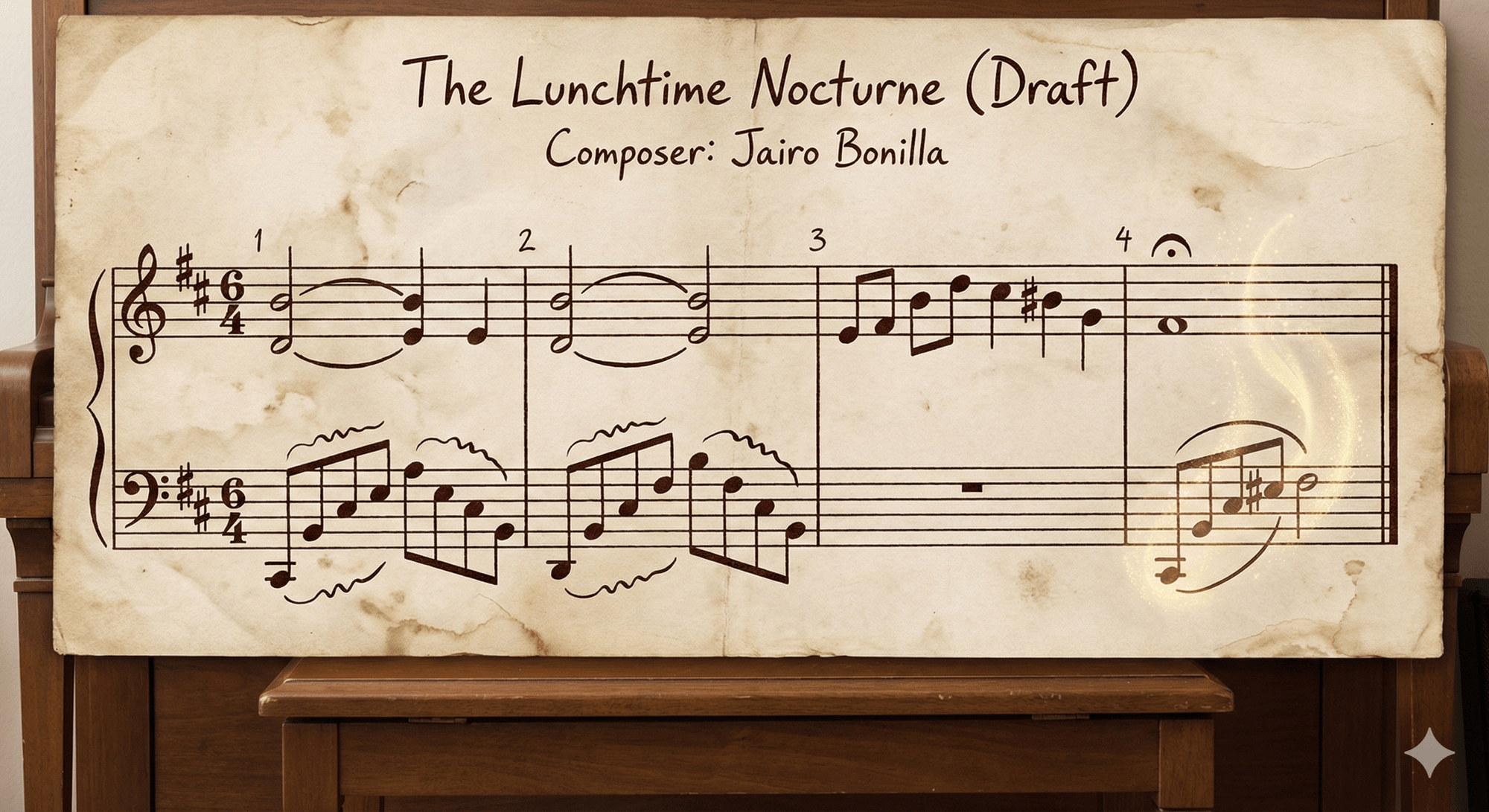
I am performing my personal composition—originally written in the key of D Minor—over a relentless, driving techno trance beat from a Tempo Radio MX special. On the surface, it is a performance. Beneath the surface, it is a high-speed chase.

The challenge? The DJ track is not static. Over the course of one hour, the mix modulates and shifts keys at least ten times without warning.

More Than a Metronome

There is a distinct difference between playing to a metronome and playing to a trance beat. A metronome is a tool; a techno track is a living, breathing entity. It demands a response.

I describe this interaction not just as a session, but as a form of intimate musical alchemy. When the track shifts, I must shift with it—instantaneously. There is no sheet music for this moment. There is only the ear, the hand, and the split-second decision to plug in the correct chords seamlessly.

The Result: A Seamless Concert

To the audience, the transitions appear effortless, as if the piano and the synthesizer are speaking the same language. And in a way, we are. It is a one-hour journey where I surrender to the rhythm, allowing my composition to evolve and breathe within the electronic landscape.

It is sophisticated. It is alluring. And most importantly, it is happening right now.

Continue reading “The Invisible Conductor: Finding Harmony in Chaos”

The Renaissance Manifesto: Beyond the Hamster Wheel

In a world conditioned to “tap, tap, tap” for digital approval, I’ve decided to keep my hands on the piano keys and my eyes on the canvas.

Lately, I’ve been watching the “Incentive Programs” and the “Creator Battles” that dominate our screens. I see grown men and women begging for digital hearts and virtual gifts, trapped in what I call the “Hamster Wheel Showcase.” It is a cycle of external embarrassment where the algorithm tells you how to act, what to say, and how to plead for attention.

I’m not a gamer, and I’m not a beggar. I am a Modern Renaissance Man.

As a pianist, photographer, composer, and father, my goal isn’t to chase points—it’s to build a community. My “About Me” isn’t a list of stats; it’s a lifestyle of polymathic pursuit:

• The Music: If you see hearts filling my screen while I’m mid-Nocturne, know that I’m too deep in the melody to see them—but I am everly thankful for the connection.

• The Art: When I draw the sacred geometry of the Flower of Life, I am looking for precision, not “likes.”

• The Philosophy: I believe in “Slow Growth, High Value.” I refuse to stoop to the level of “Tiki Tiki” conditioning.

To my fellow creators and readers: You don’t have to do what the algorithm tells you. You don’t have to change your niche or your dignity to “trend.

I will continue to juggle my platforms—photography, calisthenics, music, and language—on my own terms. I invite you to step off the wheel and join me in the studio. Let’s create something that lasts longer than a digital rose.

A Note on Gratitude

To those who have joined my Lives and filled the screen with hearts while I was lost in my piano or my drawings: Thank you. Your support is felt, even when I’m too busy composing to see the screen. I record those moments not as “points,” but as proof that real art still moves people.

Stay authentic. Stay a “contender.”

— Jay

21 de enero de 2026

El Manifiesto del Renacimiento: Más allá de la “Rueda de Hámster”

En un mundo condicionado a dar “tap, tap, tap” para obtener aprobación digital, yo he decidido mantener mis manos en las teclas del piano y mis ojos en el lienzo.

Últimamente, he estado observando los “Programas de Incentivos” y las “Batallas de Creadores” que dominan nuestras pantallas. Veo a hombres y mujeres adultos rogando por corazones digitales y regalos virtuales, atrapados en lo que yo llamo la “Rueda de Hámster de las Apariencias”. Es un ciclo de vergüenza ajena donde el algoritmo te dice cómo actuar, qué decir y cómo suplicar por atención.

Yo no soy un “gamer”, y no soy un mendigo. Soy un Hombre del Renacimiento Moderno.

Como pianista, fotógrafo, compositor y padre, mi objetivo no es perseguir puntos, sino construir una comunidad. Mi sección “Sobre mí” no es una lista de estadísticas; es un estilo de vida de búsqueda polímata:

• La Música: Si ves corazones llenando mi pantalla mientras estoy en medio de un Nocturno, debes saber que estoy demasiado sumergido en la melodía para verlos, pero estoy profundamente agradecido por la conexión.

• El Arte: Cuando dibujo la geometría sagrada de la Flor de la Vida, busco precisión, no “likes”.

• La Filosofía: Creo en el “crecimiento pausado con alto valor”. Me niego a rebajarme al condicionamiento del “Tiki Tiki”.

A mis compañeros creadores y lectores: No tienen que hacer lo que el algoritmo les ordena. No tienen que sacrificar su nicho ni su dignidad para ser “tendencia”.

Continuaré alternando mis pasiones —la fotografía, la calistenia, la música y los idiomas— bajo mis propios términos. Los invito a bajarse de la rueda y acompañarme en el estudio. Vamos a crear algo que dure más que una rosa digital.

Una nota de gratitud

A todos los que se han unido a mis transmisiones en vivo y han llenado la pantalla de corazones mientras yo estaba perdido en mi piano o en mis dibujos: Gracias. Siento su apoyo, incluso cuando estoy demasiado ocupado componiendo para mirar la pantalla. Grabo esos momentos no como “puntos”, sino como prueba de que el arte real todavía conmueve a las personas.

Mantente auténtico. Mantente como un verdadero contendiente.

— Jairo Bonilla