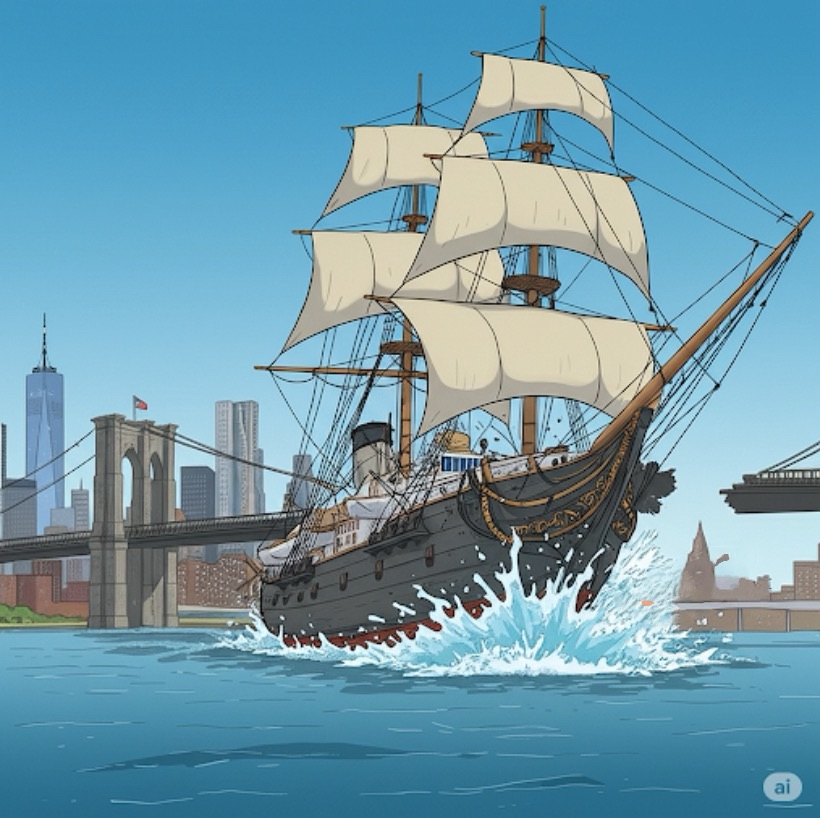
Monday May 19, 2025

Mexican Navy tall ship crashes into Brooklyn Bridge, killing two – https://www.reuters.com/world/us/mexican-navy-sailing-ship-crashes-into-brooklyn-bridge-19-injured-2025-05-18/http://Mexican Navy tall ship crashes into Brooklyn Bridge, killing two – https://www.reuters.com/world/us/mexican-navy-sailing-ship-crashes-into-brooklyn-bridge-19-injured-2025-05-18/

Interesting post, but there’s a key piece of the puzzle missing! For those who know the East River and Hudson River, it’s common knowledge that large vessels – think massive cruise ships or impressive tall ships like the Mexican navy’s – don’t just sail out into the Atlantic on their own. They are always accompanied, often towed, by a dedicated towing boat for safe passage.

https://www.tiktok.com/t/ZP86nbYCV/

Today, May 19, 2025, NBC News issued a breaking news announcement where New York City Mayor Adams provided very few details regarding the tragic accident that claimed the lives of two Mexican Navy Marina sailors.

This story is a powder keg, and I’m sounding the alarm because those of us familiar with the Hudson and East Rivers—the waters surrounding Manhattan—know that large vessels like this one never navigate alone. This isn’t just common sense; it’s a clear violation of New York City Marina and Coast Guard regulations.

Here a break down of NYC Marina and Coast Guard laws and protocols specifically for Manhattan, where I reside. So stay tuned for some local knowledge.

Okay, here’s a focused section on the U.S. Coast Guard’s role in responding to and escorting large vessels.


U.S. Coast Guard and the Escorting of Large Vessels.


The U.S. Coast Guard plays a critical role in ensuring the safe navigation of large vessels within U.S. waters, including busy and complex waterways like the Hudson and East Rivers surrounding Manhattan. Their involvement in escorting these vessels isn’t merely a suggestion; it’s often a mandated requirement driven by safety and security protocols.
Here are key aspects of the Coast Guard’s responsibilities in this area:

  • Navigation Safety Mandates: The Coast Guard has broad authority to establish regulations that ensure the safe movement of vessels. For large ships, which can have limited maneuverability, especially in confined channels or areas with strong currents and tides, the Coast Guard often requires the presence of tug escorts. These requirements are put in place to mitigate the risk of groundings, collisions, and other maritime accidents.
  • Vessel Traffic Services (VTS): In major ports like New York Harbor, the Coast Guard operates Vessel Traffic Services. Large vessels are typically required to communicate with and follow the guidance of VTS. This system actively monitors vessel movements and can direct or mandate the use of escorts to ensure safe and efficient traffic flow.
  • Risk Assessment: The decision to require escorts is often based on a risk assessment that considers factors such as the size and draft of the vessel, the dimensions and characteristics of the waterway (width, depth, bends), the density of other vessel traffic, and prevailing environmental conditions (weather, visibility, currents).
  • Security Considerations: In the post-9/11 era, security has become an even greater priority. The Coast Guard establishes security zones around critical infrastructure and certain high-interest vessels. Escorts can be part of a comprehensive security plan to ensure these vessels transit safely and are protected from potential threats.
  • Enforcement Authority: The Coast Guard has the authority to enforce these regulations. Vessels that fail to comply with escort requirements or other navigational safety rules can face penalties, including fines and potential delays or restrictions on their movement.
    In the specific case of a large vessel like the Mexican Navy tall ship navigating the Hudson and East Rivers, it would be almost certain that the U.S. Coast Guard would have been actively involved in planning and overseeing its transit, likely mandating the use of tug escorts to ensure the safety of the vessel, the waterway, and other maritime traffic. This is a standard operating procedure for large, less maneuverable vessels in such a demanding environment.
    This section highlights the proactive role of the U.S. Coast Guard in ensuring the safe passage of large vessels through critical waterways by often requiring and coordinating escort services.

By, Meshekatlan

May 2025 Mexican Navy Ship Crashes claiming 2 lives on board.

This is indeed a tragic event. The Mexican Navy Tall Ship, “The Cuauhtémoc,” suffered a sudden loss of power on May 18, 2025, while navigating the East River. Adrift and at the mercy of the strong currents, the vessel tragically collided with the iconic Brooklyn Bridge. This devastating incident has claimed the lives of two people and caused significant damage to both the ship and a section of the bridge. Authorities have launched an investigation to determine the precise cause of this heartbreaking collision.
As a native New Yorker, the sight of a tall ship on the East River feels particularly unusual. Larger vessels, including cruise liners, are typically seen navigating the Hudson River, a waterway often associated with a more upscale environment. The unfathomable nature of this accident compounds the sorrow I feel for the victims and the profound calamity their families now face. The sudden loss of power rendered the “Cuauhtémoc” vulnerable, and the subsequent lack of control tragically culminated in this devastating collision, leaving a community in mourning and a landmark bearing the scars of this unforeseen disaster.

The mayor has launched a “go team” specialized in accidents such as these and a full investigation was launched.

For Spanish version: Scroll down.


Este es, de hecho, un evento trágico. El buque escuela de la Armada Mexicana, el “Cuauhtémoc”, sufrió una repentina pérdida de energía el 18 de mayo de 2025 mientras navegaba por el East River. A la deriva y a merced de las fuertes corrientes, la embarcación chocó trágicamente contra el icónico Puente de Brooklyn. Este devastador incidente ha cobrado la vida de dos personas y ha causado daños significativos tanto al barco como a una sección del puente. Las autoridades han iniciado una investigación para determinar la causa precisa de esta desgarradora colisión.
Como nativo neoyorquino, la visión de un barco de gran calado en el East River resulta particularmente inusual. Los buques más grandes, incluidos los cruceros, se ven típicamente navegando por el río Hudson, una vía fluvial a menudo asociada con un ambiente más exclusivo. La naturaleza incomprensible de este accidente agrava la pena que siento por las víctimas y la profunda calamidad que ahora enfrentan sus familias. La repentina pérdida de energía dejó al “Cuauhtémoc” vulnerable, y la subsiguiente falta de control culminó trágicamente en esta devastadora colisión, dejando a una comunidad de luto y a un monumento histórico con las cicatrices de este desastre imprevisto.

De Meshekatlan.

Sunday, May 18, 2025 

Mexican Navy Tall Ship “The Cuauhtemoc,”crashes into the iconic Brooklyn Bridge.

The Navy Tall Ship was reported to have lost power, this horrible accident has claimed the lives of two people. The force of the impact caused significant damage to both the boat and a section of the bridge. After losing power, the boat was dragged by the currents thus, crashing into the Brooklyn Bridge, at which point the collision is now under investigation to determine the exact cause.

https://www.tiktok.com/t/ZP86scDPv/

Mexican Navy tall ship crashes into Brooklyn Bridge, killing 2 – https://www.reuters.com/world/us/mexican-navy-sailing-ship-crashes-into-brooklyn-bridge-19-injured-2025-05-18/

http://Mexican Navy tall ship crashes into Brooklyn Bridge, killing 2 – https://www.reuters.com/world/us/mexican-navy-sailing-ship-crashes-into-brooklyn-bridge-19-injured-2025-05-18/

This horrible collision has tragically claimed two lives. As a native New Yorker, I find it unfathomable to see a tall ship on the East River; everyone here knows these larger vessels, including cruise liners, primarily use the Hudson, a riverfront often characterized by its upscale atmosphere. My heart goes out to all the victims of this tragedy, and calamity for the families affected.

This is indeed a tragic incident. The sudden loss of power on the Navy Tall Ship rendered it vulnerable to the strong currents of the waterway. Consequently, this lack of control tragically led to the devastating collision with the Brooklyn Bridge, resulting in the heartbreaking loss of two lives and substantial structural damage.

https://youtube.com/shorts/rtOQ_2I22Xo?si=tWRhztl90R_sYDjK


News articles about this incident:

(as of Sunday, May 18, 2025):

  • Details of the Incident:
  • A Mexican Navy training tall ship, identified as the Cuauhtémoc, was involved in the collision with the Brooklyn Bridge on Saturday evening, May 17, 2025.
  • The collision occurred around 8:30 PM Eastern Time.
  • Initial reports suggest the ship lost power due to a mechanical issue, causing it to drift and collide with the bridge. Some reports also mention a loss of steering power.
  • Eyewitness accounts describe the ship moving backward towards the bridge.
  • Videos circulating online show the ship’s masts striking the bridge and breaking apart.
  • Casualties and Injuries:
  • Tragically, two people on board the ship have died.
  • The number of injured is reported to be around 19-22, with some in serious or critical condition.
  • There were approximately 277 people on board the vessel.
  • No injuries to people on the Brooklyn Bridge have been reported.
  • Damage:
  • The ship sustained significant damage, particularly to its masts.
  • Preliminary inspections suggest the Brooklyn Bridge did not suffer major structural damage and has been reopened.
  • Investigation:
  • The National Transportation Safety Board (NTSB) is reportedly launching a “go-team” to investigate the cause of the collision.
  • Local authorities are also investigating the mechanical issues that may have led to the power loss.
  • The Tall Ship:
  • The Cuauhtémoc is a three-masted training vessel for the Mexican Navy.
  • It was on a goodwill tour and had visited New York City, with public tours offered.
  • The ship was reportedly departing from Pier 17 in Manhattan and was en route to Iceland.
  • The vessel is approximately 297 feet long and its main mast is about 147-160 feet tall.
  • There were cadets on board as part of a training cruise.
  • Local Reaction and Context:
  • Eyewitnesses described chaotic scenes and panic following the collision.
  • The presence of a tall ship on the East River is noted as unusual by locals, as these types of vessels typically navigate the Hudson River.
    Suggested Search Terms for this New Article
  • “Brooklyn Bridge ship collision”
  • “Mexican Navy tall ship Brooklyn Bridge”
  • “Cuauhtémoc Brooklyn Bridge”
  • “East River tall ship accident”
  • “Brooklyn Bridge maritime incident May 2025”

America The Beautiful

History, Health, expolitics, science, art, music, nature word events, news

Skip to content ↓